

Hull materials & armor guide · Sitka Engineering · Grants Pass, Oregon
5086 vs 5052 marine aluminum and UHMW bottoms for river jet boats
Reading a shallow riffle at twenty five miles an hour feels completely different when you trust what is under your feet. Pick the right alloy, bottom thickness, and rock armor before you strike an arc, and your hull shrugs off cobble bars, beaches cleanly at camp, and stays straight season after season.
Every Sitka hull kit cut in Grants Pass, Oregon combines CNC cut 5052 and 5086 marine aluminum with model-specific bottom thickness and UHMW upgrades, plus a separate 1/2 inch HDPE outboard sled option. Here is how each material behaves on real rivers and how to spec your build without adding dead weight you do not need.
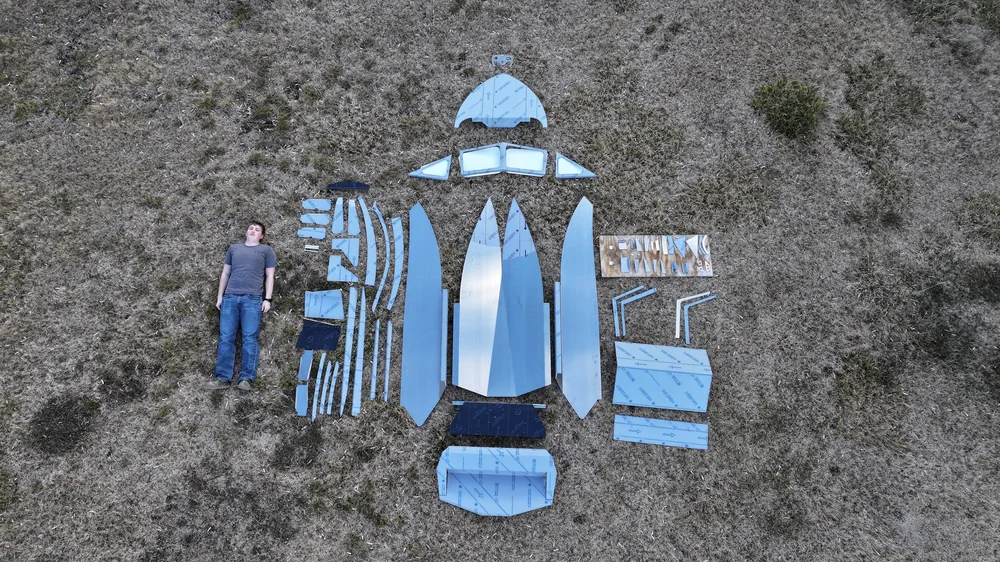
Why welded aluminum boat hulls use 5052 and 5086 instead of 6061
First time builders shopping metal suppliers often ask why structural 6061 T6 plate shows up in machine shops and aircraft parts while serious Pacific Northwest river boats rely on 5052 and 5086 marine aluminum. The answer comes down to what happens when you bend a bow curve and lay down forty feet of continuous weld bead.
5052 and 5086: strain hardened for forming and welding
- Retains strength beside the weld: 5000 series marine alloys draw their strength from magnesium alloying and cold rolling rather than fragile oven heat treatment. After TIG or spool gun MIG welding with 5356 wire, the weld zone stays tough and ductile.
- Bends without cracking on shop stands: Tab and slot Sitka hulls pull up into compound bow and chine shapes with ratchet straps and clamps, no dedicated hull jig required. Both 5052 and 5086 form cleanly along brake lines and bow sweeps without splitting.
- Saltwater and river corrosion resistance: High magnesium content shrugs off brackish estuaries, road salt on winter trailers, and unpainted bilge moisture.
Where 6061 belongs on a jet boat (and where it does not)
6061 T6 loses a steep share of its temper strength in the heat affected zone next to a weld, and tight cold bends can fracture along the grain. On a shallow river hull that flexes over gravel bars, brittle weld zones invite fatigue cracks.
Where 6061 shines is thick CNC machined hardware that does not depend on sheet forming. That is why Sitka machines solid billet parts like our billet bow tie down, billet stern tie downs (built to outlast cast tie downs that snap under strap tension), and billet grab handle, while reserving 5052 and 5086 exclusively for welded hull sheets, stringers, and intake tunnels.
5086 vs 5052 marine aluminum: where each grade earns its keep
Think of 5052 and 5086 as teammates inside the same hull rather than rivals. A smart river boat puts lighter, easy forming 5052 everywhere weight savings help you plane shallower, and puts higher yield 5086 right where rocks try to dent the bottom.
| Property | 5052 H32 marine aluminum | 5086 H116 / H32 marine aluminum |
|---|---|---|
| Nominal magnesium content | Roughly 2.5% magnesium with chromium for smooth formability and fatigue resistance. | Roughly 4.0% magnesium with manganese for higher yield and tensile strength. |
| Typical yield strength | Around 28,000 psi (193 MPa) before welding; forms tight radius bends and compound flares with ease. | Around 30,000 to 37,000 psi (207 to 255 MPa) depending on temper, retaining higher post weld yield strength. |
| Rock impact & dent resistance | Great elasticity on light hulls, hull sides, bulkheads, floors, and calm to moderate gravel rivers. | Superior resistance to localized denting and hooking between stringers when a loaded hull lands on cobbles or ledge rock. |
| Welding filler metal | 5356 MIG wire or TIG rod. | 5356 MIG wire or TIG rod (welds seamlessly to 5052 stringers, sides, and transoms). |
| Primary Sitka kit applications | Hull sides, bows, decks, standard 1/8 in stringers, fuel tank seats, engine covers, and standard 1/8 in or 3/16 in bottoms. | Upgraded 3/16 in and 1/4 in rock bottoms, heavy center sections, and all 3/16 in 5086 weld-in intake tunnels. |
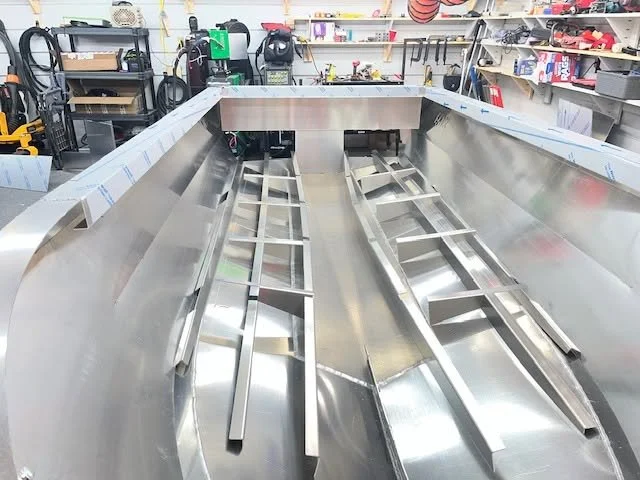
Bottom plate, stringer, and UHMW options across all 9 Sitka hull kits
Alloy grade is only half the equation: plate thickness and internal stringer spacing decide how much weight your boat carries and how hard a hit the running surface can absorb. Every option below comes directly from Sitka’s live kit configurators across our 6–14 ft mini jet boat kits and 15–20 ft river hull kits.
| Sitka model & base kit price | Standard bottom & stringers | Available aluminum bottom & stringer upgrades | Available UHMW armor options |
|---|---|---|---|
| 6ft Nano From $1,600 USD |
1/8 in 5052 bottom (~120 lb bare hull) | 3/16 in 5086 bottom (+$480) | 1/4 in UHMW (+$420) |
| 8ft Rowdy From $2,400 USD |
3/16 in bottom | 3/8 in aluminum center section (+$425) | Cut and formed 1/4 in UHMW (+$420) or 3/8 in UHMW (+$600) |
| 10ft Scout From $3,450 USD |
3/16 in bottom, 1/8 in stringers | 1/4 in 5086 bottom (+$510); 3/16 in stringers (+$375) | 3/8 in UHMW (+$690) or 1/2 in UHMW (+$850) |
| 12ft Sidekick From $4,400 USD |
3/16 in standard bottom | 1/4 in bottom upgrade (+$462) | 3/8 in UHMW (+$690) or 1/2 in UHMW (+$850) |
| 14ft Creekboat From $4,200 USD |
3/16 in standard bottom | 1/4 in 5086 bottom (+$425) | 3/8 in UHMW (+$690) or 1/2 in UHMW (+$850) |
| 15ft Sportsman From $6,450 USD |
3/16 in bottom, standard center section | 1/4 in 5086 bottom (+$810); 3/8 in (+$640) or 1/2 in (+$825) aluminum center section | 3/8 in center UHMW (+$690), 1/2 in center UHMW (+$850), or 1/2 in complete UHMW (+$1,350) |
| 1668 CreekBoat From $6,400 USD |
1/4 in center section, 3/16 in bottom wings, 1/8 in stringers | 3/8 in (+$740) or 1/2 in (+$825) center section; 1/4 in bottom wings (+$810); 3/16 in stringers (+$520) | 1/2 in UHMW protection (+$850) |
| 20ft Wolverine $12,500 USD |
Heavy open bow whitewater aluminum hull (20 ft bow to transom, 22 ft overall) | Engineered for V8 and two-stage river jet packages; request custom plate options | Custom whitewater UHMW bottom layouts supported |
| 20ft HDPE Sled $9,500 USD |
Precut 1/2 in HDPE bottom, sides, bow, and transom | Plastic welded polymer sled for outboard jet power (distinct from aluminum jet hulls) | Inherent full hull polymer slide surface |
Not sure whether your home water calls for standard 1/8 inch or 3/16 inch sheet versus full 1/4 inch 5086 and 1/2 inch UHMW? Match your draft, payload, and donor horsepower on our kit comparison page and shallow water jet boat guide. If you are building solo and keeping total hull weight down for pickup bed loading, read our one person jet boat guide.
How UHMW rock armor works (and how it differs from an HDPE sled)
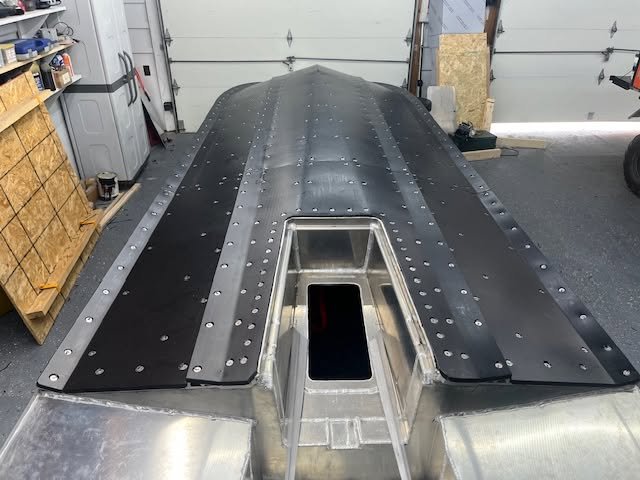
Watch a bare aluminum boat touch a dry sun baked gravel bar at low speed and you will see why whitewater builders love UHMW: bare aluminum has high friction against dry rock and tends to stick, gall, and leave shiny silver streaks behind. Bolt a sheet of black UHMW under that exact same hull and the boat glides over wet or dry cobbles like ski base material on snow.
When adding UHMW pays off immediately
- Shallow braided gravel and boulder gardens: If you routinely slide over three inch riffles, line boats over shallow ledges, or beach on sharp basalt, 1/4 inch, 3/8 inch, or 1/2 inch UHMW absorbs the gouges so your aluminum welds stay untouched.
- Center keel strip vs. full bottom coverage: Many builders armor the center delta pad ahead of the jet intake (where 80 percent of rock touches happen) to save weight and budget, while heavy whitewater runners choose complete bottom coverage like the $1,350 full 1/2 inch package on the 15ft Sportsman.
- Pair UHMW with adequate aluminum stiffness: UHMW cushions and slides, yet it bends under point loads. Always back UHMW with at least a 3/16 inch or 1/4 inch aluminum bottom and sound stringer welds so rocks cannot hook the hull beneath the plastic.
UHMW bottom armor vs. a plastic welded HDPE hull
Builders often ask why we bolt UHMW onto aluminum kits yet plastic weld our 20ft HDPE Sled. Because UHMW has ultra long molecular chains, it melts into a rubbery gel rather than flowing cleanly under an extrusion welding gun, making mechanical countersunk fasteners over a rigid aluminum frame the proven way to mount it (allowing thermal expansion as river and air temperatures swing).
High density polyethylene (HDPE) has shorter chains that fuse into full strength structural seams with a plastic extrusion welder, making 1/2 inch HDPE ideal for a low maintenance outboard jet sled while welded 5052/5086 + UHMW remains king for high speed inboard mini and river jet hulls.
Welding wire, stringer grids, and Hardox 450 intake protection
A rock proof bottom only works as well as the intake tunnel and weld seams tying it together. Three shop details separate a hull that stays crisp for twenty years from one that hooks or leaks:
- 1. Stitch and sequence with 5356 filler: Whether you run a pulsed MIG spool gun, push pull gun, or AC TIG torch, use 3/64 inch or 0.035 inch 5356 wire with pure argon shielding gas and stainless wire brushing after acetone wipe down. Moving around the hull in balanced stitch sequences keeps flat 5052 and 5086 panels straight without warping. Walk through the full tab and slot sequence in our hull assembly guide and build guide overview.
- 2. Protect the jet pump intake with 5086 + Hardox 450 steel: The last three feet ahead of the transom sit deepest when getting on plane and take the hardest rock hits. Sitka’s weld-in jet boat intake kits pair a CNC cut 3/16 inch 5086 aluminum intake tunnel with a removable Hardox 450 steel rock grate (140 mm intake for two-stroke skis at $449 USD, 155 mm intake for larger pumps at $599 USD) so river cobbles cannot crush soft cast aluminum bars into your impeller. Match your donor pump diameter in choosing a donor jet ski.
- 3. Price the upgrades into your build (or buy completed): Upgrading from a standard bottom to 1/4 inch 5086 and adding UHMW during initial assembly is far easier and cleaner than retrofitting an older dented boat later. Factor bottom and UHMW options into our mini jet boat build cost guide, read are mini jet boats worth it, browse completed mini jet boats for sale, or connect with an independent fabricator on our builder referral page. Cutting sheet on your own CNC table? See our 10ft Scout digital CAD/DXF plans.
Frequently asked questions about 5086, 5052, and UHMW boat bottoms
Is 5086 or 5052 aluminum better for a shallow water jet boat bottom?
Both 5052 and 5086 are true strain hardened marine aluminum alloys with excellent corrosion resistance and weld ductility. Choose 5052 when keeping hull weight low and pulling tight compound curves matters most, such as the 120 lb 1/8 inch 6ft Nano or hull sides, decks, and interior components. Step up to 5086 plate (such as a 3/16 inch 5086 Nano bottom or a 1/4 inch 5086 bottom on the 10ft Scout, 14ft Creekboat, 15ft Sportsman, or 1668 CreekBoat) when you carry heavier loads or run fast across shallow rocky gravel bars where higher yield strength resists denting.
Why do river jet boats avoid 6061 aluminum for welded hull skins?
6061 T6 gains its strength from artificial heat treatment rather than work hardening. Along a continuous chine or keel weld, welding heat softens the heat affected zone and lowers ductility, making 6061 hull sheets more prone to cracking when cold formed or slammed against submerged cobbles. Sitka reserves CNC machined billet aluminum for hardware like bow and stern tie downs and grab handles, while cutting welded hull skins, stringers, and intake tunnels from 5052 and 5086 marine sheet and plate.
Does UHMW replace a thick aluminum bottom plate?
No. UHMW (ultra high molecular weight polyethylene) is a slick, impact absorbing wear layer, not a structural hull frame. Bare aluminum tends to gall and grab when sliding across dry river rock, whereas UHMW glides smoothly over cobbles and shields the metal from gouges. Because UHMW flexes under load, the welded aluminum bottom plate and internal stringers underneath still have to carry the impact without hooking, which is why rocky river builds pair a 3/16 inch or 1/4 inch aluminum bottom with 1/4 inch, 3/8 inch, or 1/2 inch UHMW.
What filler rod or MIG wire should I use to weld 5052 and 5086 boat kits?
Use 5356 aluminum filler wire or TIG rod when welding 5052 to 5052, 5086 to 5086, or 5052 topsides and stringers to a 5086 bottom plate or weld-in intake tunnel. 5356 matches the magnesium chemistry of 5000 series marine aluminum, delivering higher shear strength and far better saltwater and freshwater corrosion resistance than 4043.
What is the difference between a UHMW bottom and Sitka’s 20ft HDPE Sled?
UHMW cannot be conventional plastic welded into a standalone rigid hull because its ultra long polymer chains do not flow cleanly under a welding shoe; instead, sheets of 1/4 inch to 1/2 inch UHMW are mechanically fastened over a welded aluminum hull as replaceable rock armor. High density polyethylene (HDPE) flows cleanly for extrusion plastic welding, which allows Sitka’s 20ft HDPE Sled ($9,500 USD) to be built from precut 1/2 inch HDPE panels as a dedicated outboard jet river sled.
What steel does Sitka use for jet pump intake rock grates?
Aluminum grates bend quickly when a hull lands on river boulders, so Sitka pairs a 3/16 inch 5086 marine aluminum weld-in intake tunnel with a bolt in, removable Hardox 450 abrasion resistant steel rock grate on both our 140 mm ($449 USD) and 155 mm ($599 USD) intake kits.